Part-Time Faculty, History, Washtenaw Community College · Research Associate, University of Michigan–Dearborn
KatayounMatloubi
کتایون مطلوبی
Scholar of Holocaust literature, film, and testimony, working across French, Persian, and English sources.
One question runs through this work: what can literature and film convey about violence when direct representation risks the illusion of complete knowledge?
Ph.D., Contemporary French Literature and Francophone Studies, University of Connecticut, 2025Research Associate, Hadassah-Brandeis Institute, Brandeis UniversityAnn Arbor, Michigan
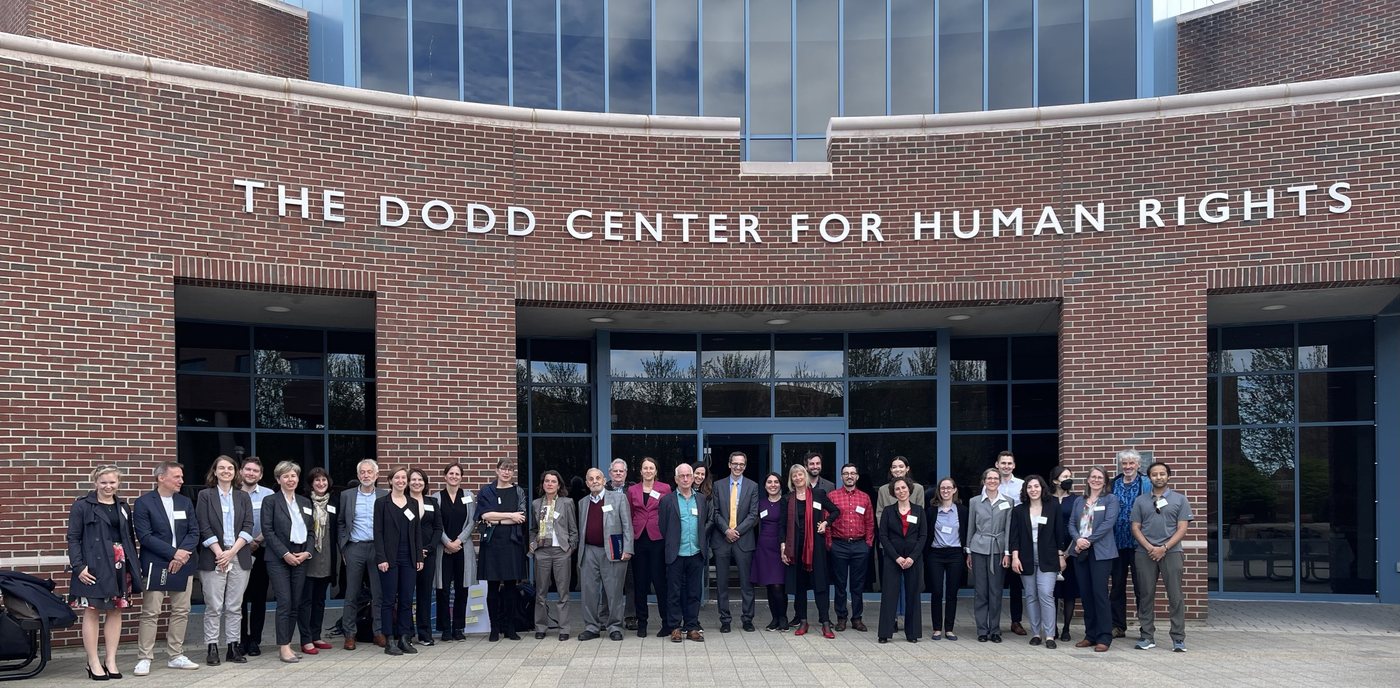
Fellowships and research programsUnited States Holocaust Memorial Museum · Hadassah-Brandeis Institute · USC Shoah Foundation · Trans-Atlantic Summer Institute, University of Minnesota · Dodd Center for Human Rights
Latest
Revised version of “Knowing Non-Knowledge” submitted to Memory Studies.
“The Persistence of the Void” published online in Holocaust Studies, open access.
Teaching HST 109, The Early Modern World, at Washtenaw Community College.
Gelman International Research Workshop at the United States Holocaust Memorial Museum, with research in the Shapell Center Reading Room.
Talk at the POLIN Museum, Warsaw: “AI, Translation, and Holocaust Memory Distortion.”
01
Research
Three current projects, and the work that has grown around them.
01 · Book manuscriptManuscript complete · in preparation for publication
The Rhetoric of Obliquity: Anna Langfus, Holocaust Cinema, and the Ethics of Indirection
When does indirection preserve the difficulty of catastrophe, and when does it shield a narrator, an artist, or an audience from knowledge?
Anna Langfus, a Polish-Jewish survivor, wrote three French-language novels and received the Prix Goncourt in 1962, yet she remains marginal in Anglophone histories of Holocaust literature. The book reads her as both the inventor of a literary obliquity and its first serious critic, then follows the problems she formalized into film.
Its central claim is that silence and restraint are not inherently ethical: their force depends on what a work withholds, from whom, and why.
Developed from the dissertation Representing the Holocaust in Novels and Films: Anna Langfus and Six Directors
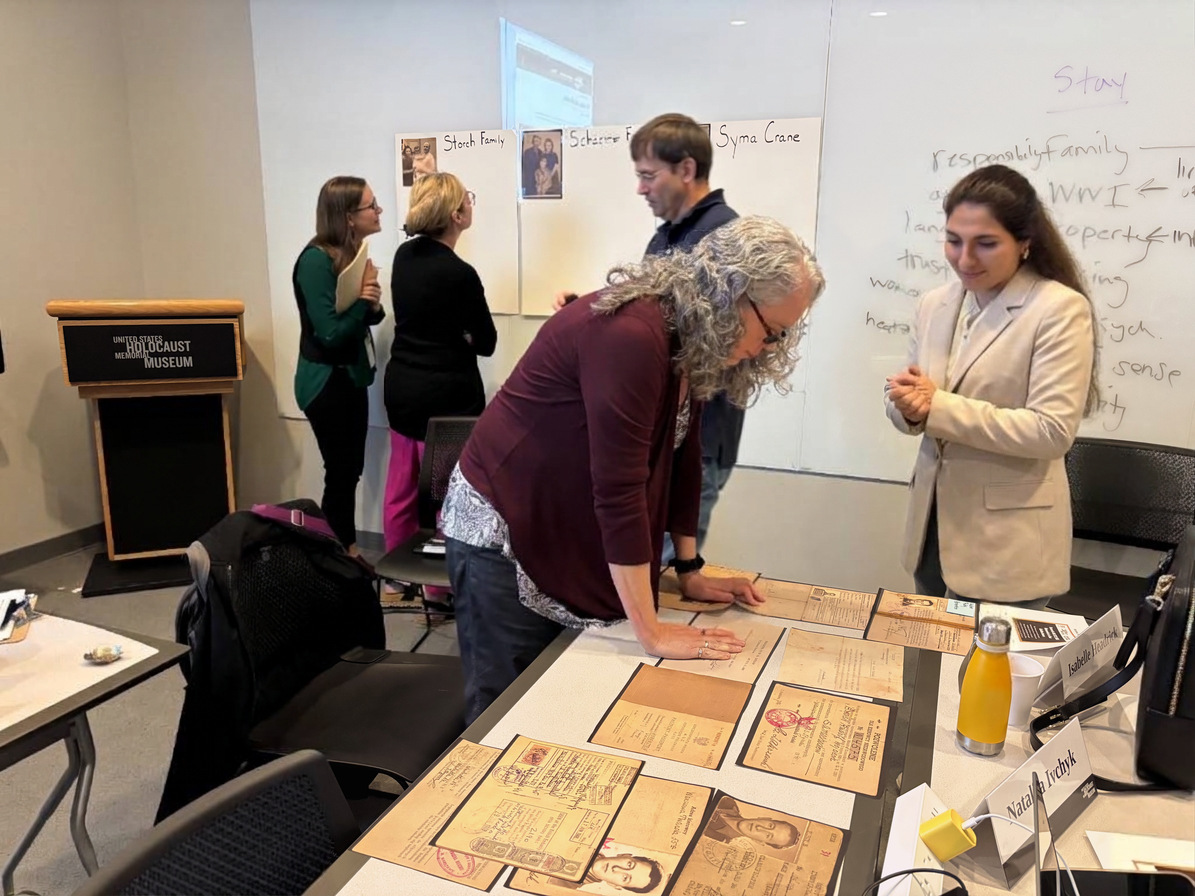
Working with archival documents, Curt C. and Else Silberman Faculty Seminar, United States Holocaust Memorial Museum, June 2025.
02 · Archival projectArchival research in progress
Classified Between: An Iranian Jewish Student in Vichy France, 1941–1944
How did Vichy institutions classify foreign Jews, and when did those classifications enter decisions about their lives?
The project follows Menashe Ezrapour, a Jewish engineering student from Hamadan, through French police and internment records, a 1941 French-language diary held by the United States Holocaust Memorial Museum, and his later testimony. It does not assume that Iranian nationality protected him; it asks how different offices made nationality legible and actionable.
In August 2026 I worked with the Museum’s French police microfilm (RG-43.016M) at the Shapell Center and collected several hundred French administrative records.
03 · MethodOngoing
Machine Translation and Holocaust Testimony
A translation may preserve dictionary meaning while resolving a hesitation, euphemism, or ambiguity that matters to the testimony.
I compare human and machine translation of Persian- and French-language Holocaust testimony. Original and translated passages are aligned, shifts in agency and uncertainty are annotated, and each interpretive claim is checked against the source.
Presented at the POLIN Museum’s “Confronting Holocaust Distortion” conference, Warsaw, November 2025.
What a correct translation can lose
Two examples from my 2025 talk at the POLIN Museum, Warsaw.
Original
Machine translation
What the reader loses
Ruthy a ensuite été envoyée en Pologne et elle a disparu.Source: Yad Vashem, Children in the Holocaust exhibition
Ruthy was then sent to Poland and she disappeared.
In French Holocaust discourse, “elle a disparu” means killed after deportation. An English reader hears only that her whereabouts are unknown.
منشه را … جابهجا میکردندSource: IranWire, testimony of Menashe Ezrapour
Menashe was moved between various labor camps.
The Persian sentence has an implicit subject: they moved him. The passive English drops the question of who moved him, and why.
Other work
Second research strandDisplacement in French-language writing and art
Négar Djavadi’s fiction and Zineb Sedira’s work: how migration and colonial histories enter French-language narrative while remaining distinct from Holocaust testimony.
Article in developmentSubtitles in Ida and The Zone of Interest
What an English subtitle track contributes to two Holocaust films, and where subtitle analysis stops being evidence.
Essay · TASI 2026Out of Tehran: Revolutionary Legibility and the Aesthetics of Revolt, 1967–1979
How an Iranian revolutionary image became legible within a European radical-left grammar, read through Foucault and Genet.
Workshop paper · USHMM 2026Fragile Negotiation and Ethical Contraction
Interaction, silence, and the contraction of social life in Gurs, Les Milles, and Bergen-Belsen.
02
Publications
Status as of November 2026. Titles appear as published or submitted.
Published articles
Holocaust Studies
The Persistence of the Void: Formal Absence in Holocaust Representation from Langfus to Ida
ChicagoMatloubi, Katayoun. “The Persistence of the Void: Formal Absence in Holocaust Representation from Langfus to Ida.” Holocaust Studies, published online October 16, 2026. https://doi.org/10.1080/17504902.2026.2742079.MLAMatloubi, Katayoun. “The Persistence of the Void: Formal Absence in Holocaust Representation from Langfus to Ida.” Holocaust Studies, 2026, https://doi.org/10.1080/17504902.2026.2742079.APAMatloubi, K. (2026). The persistence of the void: Formal absence in Holocaust representation from Langfus to Ida. Holocaust Studies. https://doi.org/10.1080/17504902.2026.2742079BibTeX
@article{matloubi2026void,
  author  = {Matloubi, Katayoun},
  title   = {The Persistence of the Void: Formal Absence in Holocaust Representation from Langfus to Ida},
  journal = {Holocaust Studies},
  year    = {2026},
  doi     = {10.1080/17504902.2026.2742079}
}
Argues against the assumption that formal absence is inherently ethical in Holocaust representation. Reads Langfus, Shoah, Son of Saul, and Ida asymmetrically, as a genealogy of mediation.
PublishedPublished online October 16, 2026
Accepted · forthcoming
Holocaust and Genocide Studies
Review of Roy Grundmann, On Shoreless Sea: The MS St. Louis Refugee Ship in History, Film, and Popular Memory (SUNY Press, 2025)
Katayoun Matloubi
AcceptedBook review · forthcoming
Under review or in revision
Memory Studies
Knowing Non-Knowledge: Perpetrator Memory and Mnemonic Form in The Zone of Interest
Katayoun Matloubi
Argues that Glazer’s film does more than dramatize Arendt’s banality of evil: through framing, duration, and sound, it places its implied spectator inside the perceptual compartmentalization it depicts.
Under reviewRevised version submitted November 13, 2026
Journal of Holocaust Research
Oblique Testimony: Holocaust Representation in Literature and Visual Art through Langfus and Boltanski
Katayoun Matloubi and José Luis Falconi
Reads Anna Langfus’s fiction alongside the installations of Christian Boltanski.
In revisionSecond revision in preparation
Book manuscript
Book manuscript
The Rhetoric of Obliquity: Anna Langfus, Holocaust Cinema, and the Ethics of Indirection
Katayoun Matloubi
Developed from the dissertation Representing the Holocaust in Novels and Films: Anna Langfus and Six Directors (University of Connecticut, 2025).
Manuscript completeIn preparation for publication
Work in progress
Article in progress
Iran, Jews, Israel, and Palestine under the Pahlavi Dynasty (1925–1979): Strategic Pragmatism, Ideological Duality, and Post-Revolutionary Legacies
Katayoun Matloubi
In progress
03
Approach
As a reader I ask what a passage rests on, and where it moves from the source to the interpretation.
My attention to the difference between silence imposed by power and silence that preserves a difficult truth is informed in part by my formation in Persian literary traditions of coded and indirect speech. That perspective does not equate Iranian histories with the Shoah; it sharpens the question of whose silence is being interpreted, under what conditions, and to what end.
What connects my projects is a method: attending to what texts, records, and translations allow us to know, and to what their forms make difficult to know. It joins close reading, archival research, and careful computational comparison.
Four questions I bring to a work
01
What does the work withhold?
02
From whom is it withheld?
03
Whose vulnerability, authority, or self-conception does the withholding protect?
04
Does the restriction deepen historical attention, or offer an escape from recognition?
The guiding questions of the book manuscript · The Rhetoric of Obliquity
04
Teaching
Courses
Winter 2027
HST 230 · History of the HolocaustWashtenaw Community College · instructor of record
Fall 2026
HST 109 · The Early Modern WorldWashtenaw Community CollegeSyllabus (PDF) ↗
2021–2024
FREN 1101–1102 · Elementary French I and IIUniversity of Connecticut · eleven sections over seven semesters, sole instructor of record
2013–2018
French and EnglishTak Sokhan Language Institute, Tabriz
Course proposal
The Iranian Revolution: History, Memory, and Transnational PoliticsTranslated Persian sources, oral history, and Inclusive History Project materials
“A course should be rigorous about what students learn and flexible about how they get there.”
From my teaching statement
The question I return to in designing a course: what will every student be able to do, say, or demonstrate at the end that was difficult at the beginning?
Student evaluations · FREN 1101, Fall 2023
4.7Overall instructor ratingout of 5
4.9Stimulated interest in the subjectdepartment average 4.5
4.9Teaching methods promoted learningdepartment average 4.4
“We were always pushed to speak in each class which really helped students learn how to speak more in French.”
“I love the way Madame Katayoun really focuses on engaging the entire class with the material.”
Response rate 81% (13 of 16). Student comments are quoted in the original.
Belfer National Conference for Holocaust Education, USHMM: teaching certificates (24 hours each), 2024 and 2025.
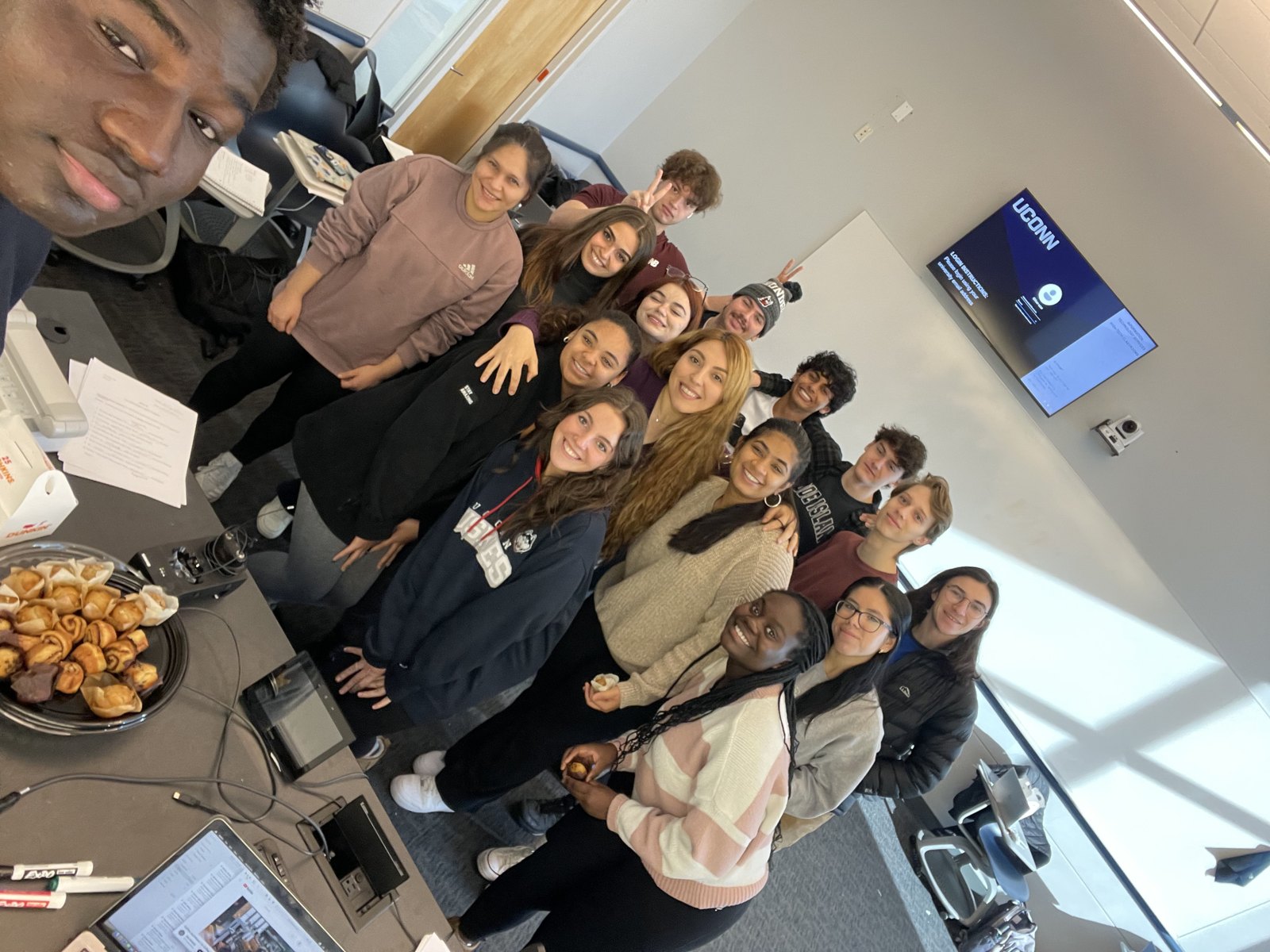
Teaching Elementary French at the University of Connecticut.
05
Experience
Academic appointments
Current 2026–present
Research Associate
Inclusive History Project, University of Michigan–Dearborn
“The University of Michigan in the Middle East”: Persian- and English-language materials on Iranian diaspora history.
Current 2026
Research Associate
Hadassah-Brandeis Institute, Brandeis University
Research affiliation; HBI Research Travel Grant, 2026.
Current 2026–present
Part-Time Faculty, History
Washtenaw Community College
The Early Modern World; History of the Holocaust.
2025–2026
Non-Residential Research Fellow
USC Shoah Foundation
Research on testimony.
2024–2025
Researcher
UConn Global Affairs and Dodd Center for Human Rights
Human rights research, University of Connecticut.
2021–2024
Graduate Instructor
Department of Literatures, Cultures and Languages, University of Connecticut
Elementary French, sole instructor of record.
Oral history and public humanities
2026
Interviewer Certification
USC Shoah Foundation
Witness-led interview protocols and archival metadata standards; two French-language interview sessions, July and August 2026.
Current 2024–present
Educational Consultant
Holocaust Awareness Museum and Education Center, Philadelphia
Curriculum and programming for Holocaust education; review of materials for scholarly accuracy.
2022–2023
Exhibition Writer (contract)
Museum of Tolerance, Los Angeles
Research briefs and interpretive texts for an exhibition on antisemitism in Tehran; translation of Persian-language recordings into English.
2022–2023
Oral history archive research
UCLA Iranian Jewish Collection · Harvard Iranian Oral History Project
Analysis of Persian-language Iranian Jewish testimony.
2020
Volunteer Translator
United Nations
Service
Current 2026–present
Steering Committee member
Abrahamic Programs, University of Connecticut
2025
Panel chair and organizer
SAMLA, Atlanta
“Knowledge After Catastrophe: Trauma, Testimony, and the Ethics of Representation.”
06
Fellowships and awards
2026Jacob and Yetta Gelman International Research WorkshopUnited States Holocaust Memorial Museum · “The Social Worlds of Internment,” August 3–14; research in the Shapell Center Reading Room
2026Broadening Academia Initiative Writing RetreatUnited States Holocaust Memorial Museum · selected participant
2026Trans-Atlantic Summer Institute (TASI) FellowUniversity of Minnesota, with DAAD support · Leuphana University Lüneburg and Marc Bloch Center, Berlin
2026Research Travel GrantHadassah-Brandeis Institute, Brandeis University
2025Curt C. and Else Silberman Faculty Seminar FellowUnited States Holocaust Memorial Museum · “Jewish Experiences Under Nazi and Soviet Occupation of Eastern Europe”
2025George Mills Harper Graduate Student Travel Fund AwardSAMLA 97 · one of two recipients
2025GAIN25 Conference GrantGerman Academic International Network
University of Connecticut
Summer Doctoral Dissertation Fellowship (2025)
HRRC International Conference Participation Award (2025)
Global Affairs Conference Travel Fund (2025)
Conference Participation Fellowship (2023)
Patti Parlette Peace Prize (2023)
Graduate School Fellowship (2021, 2023)
07
Talks
2026
When Tehran Opened Its Doors: Iranian Hospitality and the Jewish Refugees of the Second World War
Holocaust Awareness Museum and Education Center, Philadelphia
Invited
2026
Listening in the Aftermath: Sound, Memory, and Oblique Testimony in the Art of Boltanski, Shalev-Gerz, Sedira, and Bartana
20th- and 21st-Century French and Francophone Studies International Colloquium, University of Notre Dame
Refereed
2026
Genocide, Historical Trauma, and Survivor Testimony as Frameworks for Understanding Oppression
BASC 5300: Human Oppression, University of Connecticut
Guest lecture
2025
AI, Translation, and Holocaust Memory Distortion
POLIN Museum of the History of Polish Jews, Warsaw
Refereed
2025
Disorienting Knowledge: Négar Djavadi’s Philosophical Fiction at the Crossroads of Identity and Aesthetics
SAMLA, Atlanta
Refereed
2025
Coded Racial Rhetoric in Digital Discourse: Sustaining Human Rights against Far-Right Threats to Democracy
University of Tübingen · with C. Mortley
Refereed
2024
The Art of Oblique Testimony: Anna Langfus and Christian Boltanski’s Vague Renarration of Trauma
20th/21st-Century French & Francophone Studies International Colloquium · with José Luis Falconi
Refereed
2024
Read Silence: Why and How?
Roundtable, Hadassah-Brandeis Institute
Invited
2023
Rhetorics of Obliquity: The Necessity of Traumatic Representation
Department of Art, University of Connecticut
Invited
2023
Holocaust Testimony and the Ethics of Representation
Public roundtable and screening of Claude Lanzmann: Spectres of the Shoah, University of Connecticut
Public event
08
About
I am a scholar of Holocaust and memory studies, Iranian Jewish history, and transnational Middle Eastern Jewish experience.
I bring French- and Persian-language research, translation, oral-history methods, and museum education to questions of Jewish testimony and belonging. My dissertation at the University of Connecticut, advised by Roger Célestin, is the basis of my book manuscript.
I trained in French language and literature at the University of Tabriz and Shahid Beheshti University before my doctorate. I received the University of Connecticut’s Patti Parlette Peace Prize in 2023.
The full CV lists every appointment, publication, talk, grant, and training program.
Holocaust and genocide studiesIranian Jews in wartime FranceVichy internment, nationality, and minority statusTestimony and oral historyFrench and Francophone literature and filmTranslation studies and digital humanitiesArchival research (USHMM French police microfilm)Close reading and film analysisFrench/Persian source analysis and testimony comparison
Education
2025
Ph.D., Contemporary French Literature and Francophone StudiesUniversity of Connecticut · dissertation advisor: Roger Célestin
2025
Graduate Certificate in Human RightsUniversity of Connecticut
2018
M.A., French LiteratureShahid Beheshti University, Tehran · thesis on Annie Ernaux
2015
B.A., French Language and LiteratureUniversity of Tabriz